Record exactly when the fuse opens
Do not spend a box of fuses repeating the same test. Use one correct replacement only after making the circuit safe, and observe the timing:
- Blows during insertion with everything off: suspect an always-powered short, failed component or wire touching ground.
- Blows when a particular switch is pressed: focus downstream of that switch, including the load and any wiring that moves.
- Blows after the motor runs for a while: suspect overload, mechanical binding, overheating or a motor drawing more current as it works.
- Fuse is intact but the holder is hot: suspect a loose, corroded or weak fuse-panel connection rather than a simple overcurrent.
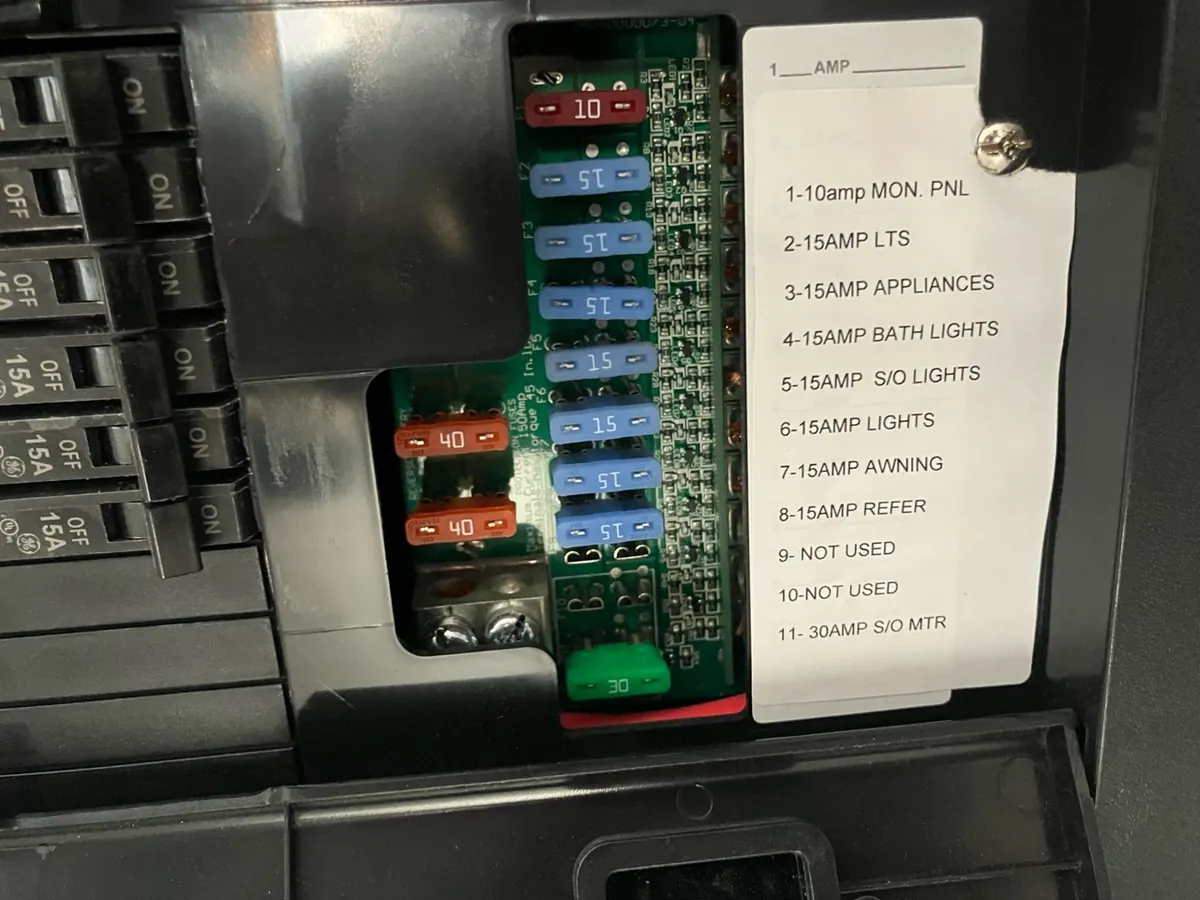
Name everything on the branch
An RV panel label may say “appliances,” “lights” or “accessories” even when several devices share the fuse. Turn off and unplug every known load on that branch. Include USB outlets, tank heaters, radios, control boards and aftermarket accessories that may not appear on the original label.
Photograph the panel before pulling fuses. If the label is unclear, remove only the suspect fuse and note which equipment loses power. Do not move fuses between positions or assume every empty slot is unused.
Disconnect loads before chasing hidden wire
The quickest safe isolation method is to divide the circuit. Remove power, disconnect the easiest accessible loads one at a time, insulate loose terminals, then retest with the correct fuse.
- Start with the appliance that was operating when the fuse failed.
- Disconnect recently installed accessories or repaired fixtures next.
- If the fuse holds with one item disconnected, inspect that item's wiring and mechanical condition before replacing it.
- If every load is disconnected and the fuse still opens, the harness between the fuse and those branches is likely shorted.
On a pump, fan, slide or awning, inspect where wiring flexes. A wire can look normal at rest and touch metal only while the mechanism moves.
Inspect the places RV wiring gets hurt
- screws added through walls, cabinets or flooring;
- slide rooms, hinges and folding step mechanisms;
- sharp frame holes and missing grommets;
- pump and furnace wiring that rubs from vibration;
- roof or exterior compartments where water entered;
- rodent damage and insulation packed around wires;
- battery work where polarity was reversed or a cable was pinched.
Follow evidence. A recent screw, wet compartment, burned smell or scrape mark deserves attention before an inaccessible factory harness is opened.
Use a meter without feeding the short
With the battery disconnected and all other power sources isolated, a qualified person can use resistance or continuity testing to locate a shorted branch. First confirm the circuit is actually de-energized; converters, solar controllers, inverters and tow-vehicle charge lines can keep 12-volt circuits live after one battery cable is removed.
Disconnect electronic modules before interpreting continuity to ground because motors, lamps and control boards may create a normal path that looks like a short on a simple continuity beeper. A current-limited diagnostic tool or resettable test breaker can reduce wasted fuses, but it does not make an overloaded circuit safe and should be used only by someone who understands the branch rating.
If the fuse blows only while the device runs
Check the mechanical load before blaming wiring. A water pump with a blocked line, furnace blower packed with debris, awning motor at a hard stop or slide mechanism in a bind can draw excessive current. Low voltage can also make some motors run slowly and stay under load longer, although a correctly rated fuse should not be treated as the cure for a weak battery.
Measure current only with a meter and method rated for the expected load. Never place a typical multimeter across the fuse terminals in amperage mode unless the meter, leads and procedure are designed for that circuit; doing so can create a direct short or damage the meter.
If the fuse or fuse holder gets hot but does not blow
Heat at one fuse blade or a browned panel can result from resistance at a loose connection. Current may be within the fuse rating while the poor contact produces local heat. Turn the circuit off and arrange repair of the terminal or distribution board. Replacing only the plastic fuse may not correct a weakened socket.
What the result proves
- Fuse holds after one load is unplugged: inspect that appliance and its short section of harness.
- Fuse still blows with all loads disconnected: trace the branch harness for a short to ground.
- Fuse blows only at one end of travel: look for a stalled motor, hard stop or flexing wire.
- Fuse is hot or discolored but intact: inspect the holder and terminal tension.
- Several unrelated fuses fail: stop and check battery polarity, charging voltage, water intrusion and distribution-panel damage.
Frequently asked questions
Why does the fuse blow as soon as I install it?
An immediate failure with loads switched off usually indicates a short to ground, a failed connected component or an always-powered section of wiring.
Why does it blow only when an appliance starts?
The appliance may be stalled, internally shorted or overloaded, or its wiring may contact the frame only during movement.
Can I try the next larger fuse?
No. Use the circuit's specified rating. A larger fuse can let the wire or connector overheat before protection opens.
Related 12-volt help
Use the system page that matches the circuit you isolated.
When to call a professional
Use RV electrical service for a hot or melted panel, repeated fuse failure with loads disconnected, inaccessible harness damage, battery-polarity events, water in the distribution panel or any test that would require bypassing circuit protection.
Sources and review notes
This page was materially expanded and safety-reviewed on August 1, 2026. The original fuse-panel photo documents a real RV awning circuit but does not establish the rating for another RV. Littelfuse's Fuseology selection guide explains why a fuse opens during an overcurrent and why the underlying fault must be corrected. Always use the RV wiring diagram and component manual for the installed circuit. See the editorial policy.