One short pump pulse after temperature changes or recent faucet use may not identify a failure. Repeated cycling with every fixture closed means the pressure side is not holding. Do not start by adjusting the pump. Find where the pressure goes.
Create a clean pump-only test
- Disconnect city water and turn off any automatic tank-fill function.
- Put winterizing and water-heater bypass valves in their normal-use positions.
- Fill the fresh tank enough that the pump cannot draw air.
- Open a faucet until air is purged, close it firmly and let the pump reach shutoff.
- Write down how often it cycles and whether each run is a quick pulse or a long recovery.
A quick pulse every few minutes often means a small pressure loss. A pump that runs almost continuously may be drawing air, unable to reach shutoff pressure, feeding a substantial leak or operating with a valve in the wrong position.
Eliminate easy fixture leaks
Close every hot and cold faucet, outside shower knob, toilet valve, washer connection, low-point drain and spray attachment. Outside showers are easy to miss because the sprayer button can stop visible flow while the hot and cold valves remain open.
Dry fittings under sinks, behind access panels, at the toilet and around the water heater. Press dry tissue around each connection; it shows a slow seep sooner than a fingertip. Check the shower hose and faucet body, not just the showerhead.
Use isolation valves to divide the system
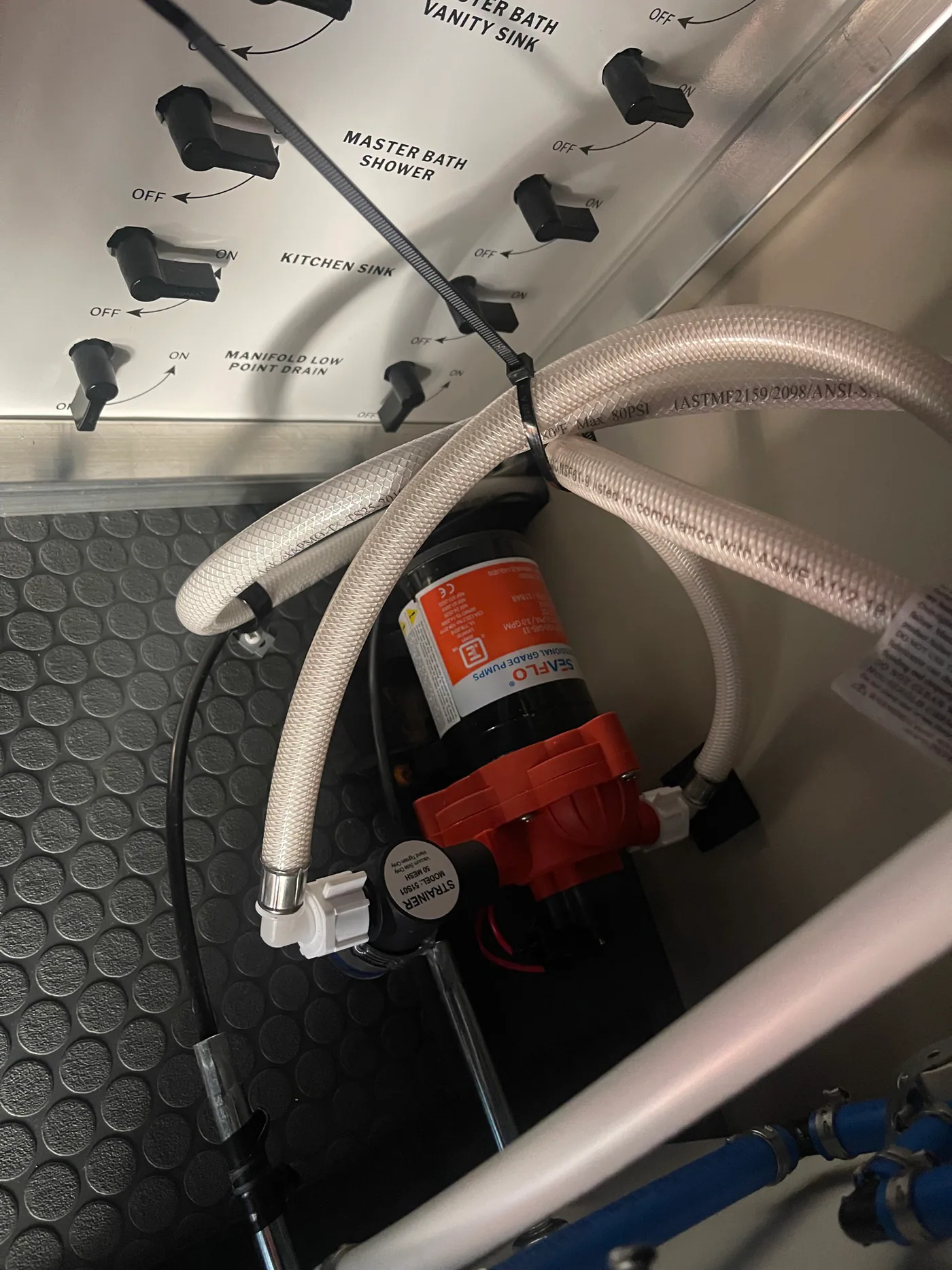
If the RV has a manifold, close one branch, wait through the normal cycle interval and observe the pump. When cycling stops after one branch is closed, inspect every fixture and fitting on that run. If no manifold exists, accessible fixture shutoffs can accomplish part of the same test.
Do not close an unidentified valve or run the pump against a blocked outlet. Some manifolds include low-point drains, tank fill or water-heater paths in addition to fixtures.
Look for a leak that does not appear inside
Water may travel along PEX, wiring, insulation or floor seams before it becomes visible. Inspect the enclosed belly and exterior openings for a new drip. Listen near the water heater, shower wall and toilet supply while the pump is quiet. A plumbing leak inside an enclosed belly can damage insulation and flooring long before a puddle reaches the living space.
If a branch remains suspect but inaccessible, leave the pump off between uses and arrange a pressure test rather than allowing repeated cycling.
Check for pressure returning toward the fresh tank
A pump can lose pressure internally through its check valve without leaking outside. Before blaming the pump, verify the city-water inlet check valve and any manual or powered tank-fill valve are fully in the correct position.
A useful related clue is a fresh tank that fills while the RV is connected to city water. Depending on the plumbing design, that can indicate a leaking pump check valve or a fill/diverter valve that is not sealing. Diagnose that condition with the pump off so city pressure and pump pressure are not confused.
Inspect pump installation before replacing it
Turn power off and inspect the inlet strainer, swivel fittings and flexible hoses. An inlet-side air leak can make a pump run erratically without producing an external water leak because the suction side draws air inward. A clogged strainer or restricted valve can also prevent normal pressure behavior.
Do not add thread tape or sealant to fittings unless the pump manual calls for it. For SHURflo 4008 pumps, the manufacturer warns that sealers or tape can contribute to housing or valve problems and specifies compatible swivel fittings. Other brands may differ.
Rule out low voltage and a weak connection
Low voltage does not usually explain why pressure disappears while the pump is off, but it can make the pump run slowly or fail to reach its normal shutoff. Measure battery voltage while the pump is running and inspect its fuse, switch, controller and ground for heat or voltage drop. A pump that cycles because a plumbing leak exists still needs the leak repaired even if electrical performance is also poor.
What each result means
- Cycling stops when one fixture branch is closed: inspect that branch for a valve, fitting or hidden line leak.
- No external leak, pressure returns toward the tank: test the pump check valve and tank-fill plumbing.
- Pump runs long and spits air: check tank level, winterizing valve, inlet strainer and suction-side fittings.
- Pump reaches shutoff but restarts with all branches isolated: the pump's internal valve or remaining shared plumbing is suspect.
- Fresh water appears in the belly or near wiring: turn every water source off and arrange repair.
Frequently asked questions
Why does the pump turn on with no faucet open?
Pressure is leaving through a fixture, hidden line, city inlet, fill valve or pump check valve. Isolate branches before adjusting the pump.
Can it cycle without a visible leak?
Yes. Water can leak inside an enclosed belly or return toward the fresh tank without appearing at a faucet.
Should the pump run while connected to city water?
Normally the pump is not needed on city water. Follow the RV plumbing instructions and turn it off during diagnosis so each supply path can be tested separately.
Continue with the result
Choose the page that matches what the isolation test revealed.
When to call a professional
Use RV plumbing service for enclosed-belly leaks, water near electrical equipment, unexplained moisture, a pump check-valve test in a tight bay or a pressure loss that remains after every accessible branch is isolated.
Sources and review notes
This page was materially expanded and safety-reviewed on August 1, 2026. The pump/manifold photo is an original RV Solver field image; valve layouts differ by coach. For a common example of pump-specific installation, strainer and fitting requirements, see Pentair's SHURflo 4008 Revolution installation and operation manual. Use the manual for the exact pump installed in the RV. See the editorial policy.