A Furrion thermostat or display that shows E1 or E2 is reporting a sensor circuit fault, not simply a room that is too hot. In official Furrion documentation for certain rooftop systems, E1 points to the indoor or control-box temperature sensor and E2 points to the indoor-coil or evaporator sensor. Current thermostat/control packages may use slightly different wording.
Do not borrow an E1 definition from a Furrion water heater or refrigerator. The same letters are reused across products.
Identify the display and rooftop model
Photograph the wall thermostat or ceiling display, the air-distribution-box label and the rooftop unit label. Search the Furrion/Lippert support library by those numbers. A 9K or 12K ceiling-control unit can have a different sensor layout from a multi-zone Chill HE package.
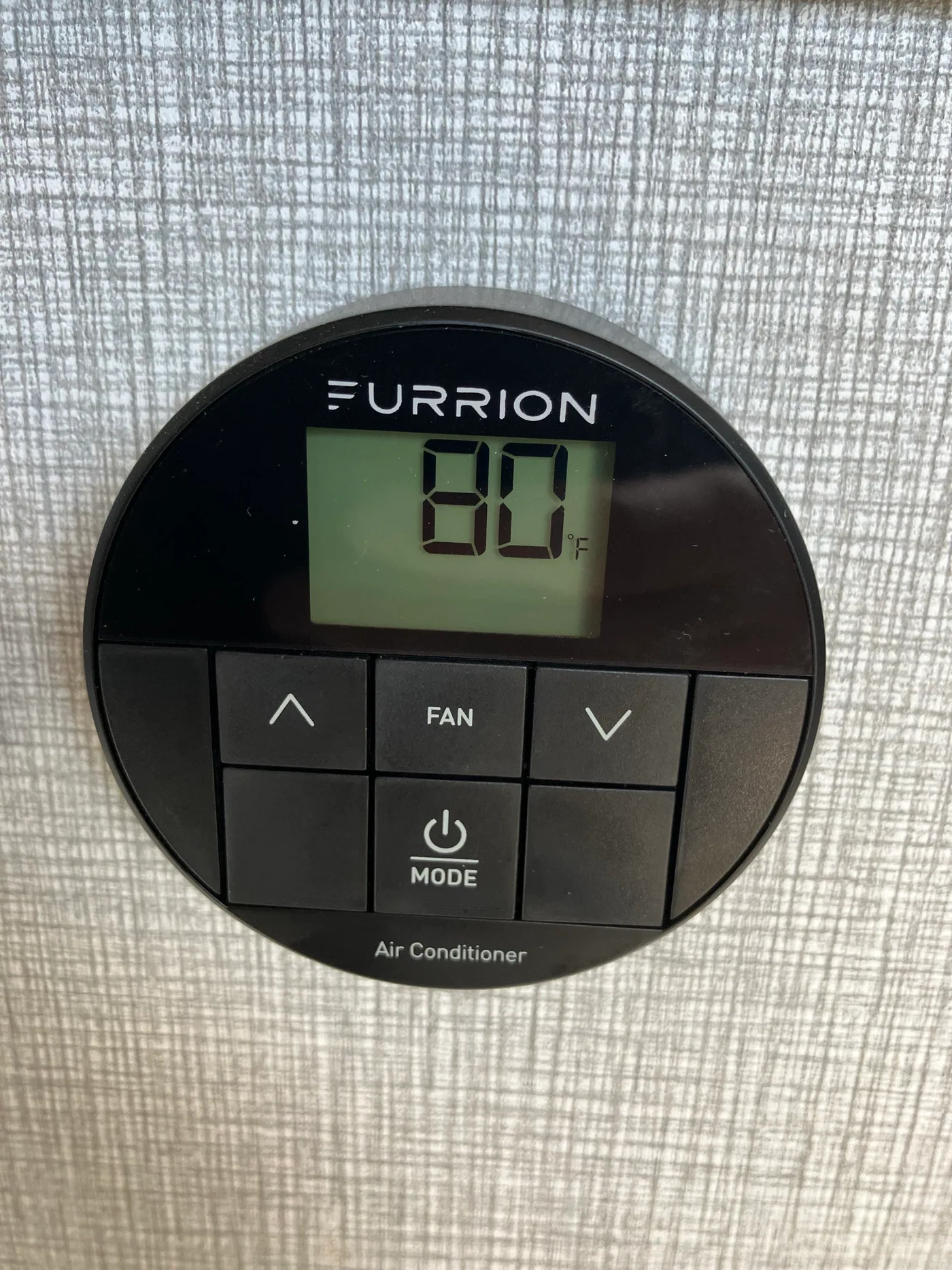
If the matched manual says E1 is the indoor temperature sensor and E2 is the indoor coil sensor, continue with that path. If it defines them differently, follow the matched table.
What an E1 sensor fault changes
The indoor temperature sensor tells the control how warm the occupied space is. If its circuit is open, shorted or disconnected, the control cannot regulate normally and may shut the system down. A sensor placed against a hot wall or direct sun can give a bad temperature reading, but a displayed E1 generally points to an electrical sensor fault rather than simple placement error.
What an E2 sensor fault changes
The evaporator or indoor-coil sensor monitors coil temperature. The control uses it to protect against freezing and manage operation. A loose butt connector, damaged sensor lead or failed sensing head can trigger E2. If the sensor has fallen away from its designed coil location without becoming electrically open, cooling behavior may be wrong even before a code appears.
Perform one controlled power reset
Turn the air conditioner off. Remove shore power, switch the generator off and isolate the 12-volt control supply as the RV manual permits. Wait several minutes, restore 12 volts and then 120 volts, and allow the normal compressor delay.
If the code clears once, monitor the system. If it returns, repeated resets will not repair a loose connector or failed sensor.
Inspect only accessible low-voltage connections
With all power proven off, check any owner-accessible plug at the thermostat or air-distribution box for a connector that is partly seated, pinched wire or moisture. Do not open the rooftop electrical box merely to look for the sensor. The official error table directs checking the sensor connection and replacing the sensing head when defective.
Keep airflow problems in perspective
A dirty filter and iced coil should be corrected, but they do not automatically explain an electrical E1/E2 sensor code. Clean the return filter and inspect for visible ice after power is off. If the coil froze before the code, a technician should verify both airflow and correct sensor attachment.
What service should test
A technician can identify the sensor, inspect its entire harness, check connector integrity and measure resistance against the temperature chart in the model service information. That separates the sensor from control-board input failure.
Do not order by code alone. Furrion has multiple control packages, and a sensor that fits one may have the wrong connector or resistance curve for another.
Related RV Solver pages
- Furrion RV AC E3 error
- Rooftop RV A/C performance test
- RV air conditioner freezes up
- RV AC thermostat not working
- Coleman-Mach thermostat blank
- Dometic CCC2 sensor error codes
Frequently asked questions
What does Furrion AC code E1 mean?
On supported Furrion rooftop systems, E1 indicates a fault in the indoor or control-box temperature sensor circuit. Verify the exact definition in the matched model manual.
What does Furrion AC code E2 mean?
On supported systems, E2 indicates an indoor-coil or evaporator temperature-sensor fault. The connector, wiring, sensor and control input may need testing.
Will resetting the Furrion thermostat fix E1 or E2?
A reset may clear a temporary communication or power event, but a returning code requires inspection of the model-specific sensor circuit.
Still narrowing it down?
The guided troubleshooter walks through RV symptoms in a safe order and helps separate a simple check from a repair that needs a technician.
Open the troubleshooterSources and review notes
Reviewed against manufacturer material on July 12, 2026. Match every fault definition, procedure, limit and replacement part to the exact model, specification and serial range installed in the RV.